
Collecting AI Models Like It’s a Hobby

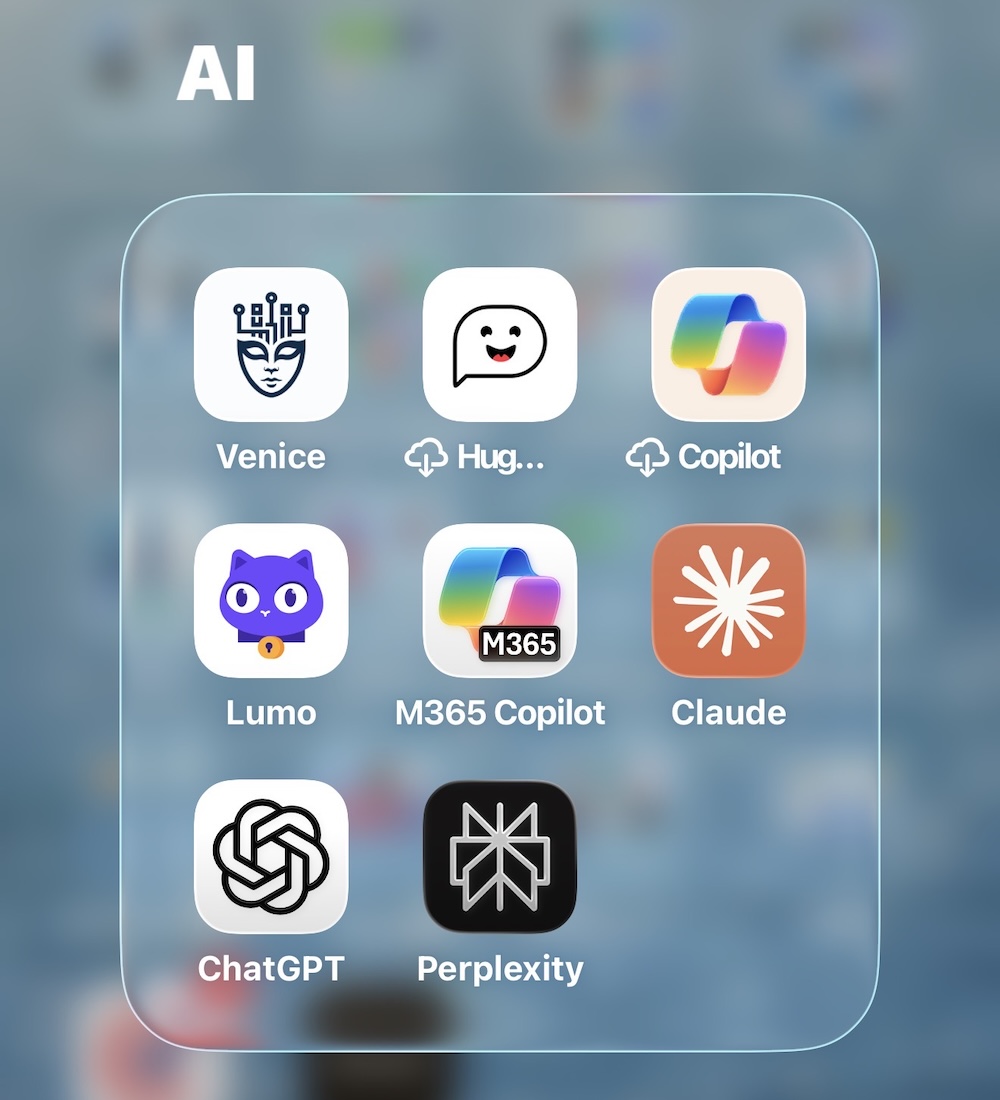
It’s almost like I collect AI models and providers. Each one has its own use case, and I probably could consolidate. But in some situations it’s not even worth the effort to do it.

As of writing this in early May 2026, and I mention the date because I usually have a backlog of a couple of months before things go live, my main tool is Claude. Well worth the money and then some.

But in addition to that I’m paying for Venice.AI as my privacy AI. Very cheap per year, limited use case, but for what it does it’s worth every penny.

Then there’s Lumo from Proton. I’m about one week into an experiment of not using it to see if I actually miss it. The honest answer is probably not, because I’m now running local models on my new MacBook Air with 32 gigs of RAM, which I got specifically to be able to do this. I’ve been running Mistral 3 3B locally and early results suggest it might actually be more private and more capable than Lumo for what I need it for. So that £120 a year might be on its way out.

I also have Perplexity Pro, which I don’t actually pay for directly. It comes bundled with another subscription I have. It’s slightly better than the others for web search type queries so I use it for that. Would I pay for it separately? Probably not. But I have it so I use it.

And then there’s ChatGPT. I touched on this in the last post but I’m currently trialling whether running Claude Code and ChatGPT’s Codex side by side is actually cheaper than paying for the next Claude tier up. The overages on Claude Code have been real, and the maths might just work out. Still figuring that one out.

So yes, I have more models and services than I probably need. Lumo is the obvious cut. Beyond that I’m genuinely not sure. The ecosystem as a whole is delivering value right now, even if it’s a bit sprawling.

What I do know is that two years in, I’m using these tools in ways I couldn’t have imagined when I first paid for Copilot on a 30 day trial just to see what would happen. And the people I talk to who haven’t really dug in yet, I get it, it can feel overwhelming. But the gap between what you can do with these tools and what most people are doing with them is pretty wide right now. And that gap is only going to get wider.


Switching to Claude

I’ve been on this AI journey for a while now, and for most of it ChatGPT was my main tool. But in February 2026 that changed.

Someone whose opinion I trust recommended I give Claude a try after voicing my frustrations with ChatGPT. When I actually sat down to evaluate it I did something that in hindsight was pretty funny. I asked Claude directly why I should use Claude over ChatGPT.

It told me not to.

Based on what I told Claude I wanted, it said I’d probably get better results from ChatGPT. So naturally I didn’t trust that answer and kept pushing. As I interrogated it further it started explaining that it was slower and more thoughtful, and from its previous read of what I was looking for, it figured I wanted fast straight answers. And that’s when something clicked for me.

One of my biggest frustrations with ChatGPT was exactly that. I’d ask it something and it would just fire back an answer. Fast, confident, and often not what I actually asked for. Like if I asked for specific instructions on how to do something on an Apple product, it would give me generic steps that didn’t even exist in the actual interface. I’d have to stop it and say don’t give me fluff, give me the actual thing. Then it would have to go look it up and either admit it didn’t know or finally give me something useful.

What Claude was describing as a weakness, slower and more considered, was exactly what I wanted. So I signed up and started using both in parallel.

Early on I was genuinely impressed with what was coming out of Claude. I was using Sonnet, the middle tier model, and the difference in output quality was noticeable pretty quickly. The concern then was whether I’d end up paying for two services. I was already paying for Venice and Lumo on the privacy side and the last thing I wanted was more sprawl.

But it became clear fairly fast that Claude was where I wanted to be. Which meant I had to migrate everything I’d built in ChatGPT over the previous six months or so. Custom GPTs, saved prompts, all of it. I had to extract everything, make sure I had backups, build a little text based database of all my prompts, and systematically move it all across.

I got it done within a month and managed to avoid paying for both services at the same time for more than one month. Then I downgraded ChatGPT to the free tier and haven’t looked back.

From a reliability standpoint Claude is better. Not perfect, and everything I said in the last post about not trusting it still applies. But it’s a meaningful improvement. And honestly, switching to it unlocked a whole new level of what I started doing with AI. Which is what the next post is about.

What I Actually Started Using AI For

I’ve been writing about my AI journey for a few posts now, and I’ve talked a lot about which tools I use and how much I trust them. But I haven’t really gotten into what I’m actually doing with them day to day. That’s what this one is about.

Trip planning was one of the first things that clicked. When you’re searching for flights and hotels, every website limits what details you can give it. With AI I could be hyper specific. If I’m flying with just the kids it’s this configuration. If my wife is with us it’s that one. These are the types of hotels we like, these are the amenities we need. It could actually hold all of that and work with it.

It didn’t book anything, but it helped me build out exactly what we were looking for and where to go look for it.

Then it evolved. I used to use Trello boards to track trips day by day, reservations, what we were doing when. Now I do all of that inside the AI itself. It exports as a YAML file I can save and reload if I need to start a fresh chat. Since privacy matters to me I’ll delete a chat when I’m done with it, but the file means I don’t lose anything. I have a general preferences file I keep updating, and then a separate file for each trip. It works really well.

I did something similar for days out with the kids. I took a week off last August and it was just me and the girls. I built out a history file of things we’d done and liked, threw in our preferences, and used it to plan the week. On Tuesday we have this, I need to figure out Wednesday, here’s a restaurant nearby that fits. I’d already been doing some of that in a neglected Trello board, but this way it was all queryable and easy to update.

Date nights with my wife got the same treatment. I’d go through our preferences, confirm them with her, and then present her with suggestions. I’ll be honest, I wasn’t exactly hiding where the ideas came from. More like, hey, I told the magic box what we like and this is what it came up with. Sometimes it was completely off. Sometimes it was genuinely spot on.

More recently it’s been helping with meal planning for the kids. Mine are picky eaters, so it was a lot of back and forth on what might actually work. It helped me land on a couple of new meals and then built a schedule to track them. Basic stuff on the surface, but genuinely useful in practice.

One that I found unexpectedly cool was using it to wrangle my Trello data. I have boards for things to watch and books to read. When I tried to pull that data into an AI the file was massive. So I had the AI help me write some scripts to strip out everything I didn’t need, took a two meg file down to about 50K, and then I could actually work with it.

Which brings me to audiobook recommendations. I was a little cautious about feeding it my reading history since it builds up a fairly personal picture of you. But I write about what I read anyway, so it felt like a reasonable trade. I’d give it what I read, when I read it, what I thought of it, and ask for recommendations.

Hit or miss, honestly. Some suggestions were weird and when I pushed back on them it would just fold immediately. That should always give you pause. But when it got it right it was actually pretty useful, and interrogating the reasoning often got me somewhere interesting even when the initial answer was off.

Which is a good lead in to something I want to dig into a bit more. It does some genuinely impressive things, but it’s far from perfect, and that part matters too.

From Sceptic to Subscriber: Beginning of My AI Story

I can’t believe I’m only now really starting to talk about some AI stuff, and ChatGPT launched in November 2022.

Looking back, I really didn’t do very much with it for over a year. The first six months was kind of like, okay, that’s cool, fine. I did a lot of reading about it separately, but I really didn’t do a heck of a lot until February 2024.

So over a year later, things were mature enough that I decided to take the plunge and try one of the paid services. Through the summer of 2023 I was definitely doing things here and there, but I was sceptical on what it could do. I was sceptical on its privacy. Well, I’m still sceptical on its privacy. But I didn’t pay for anything, and I was what you’d consider a light, casual user.

February 2024, I upgraded to Copilot. I also upgraded the family to the Microsoft 365 family plan at the same time, which you kind of need for Copilot Pro, or don’t, I forget. But there was a reason I did both at the same time. I treated it like a trial. Paid for it, but gave myself 30 days to see if I’d actually use it.

And I liked it. But the main reason I’d gone with Copilot was for the Microsoft Office integrations. That’s what sold me on it for personal use. In practice though, they just didn’t meet expectations at the time. And once I started talking to friends about it, the logic became pretty clear. Copilot is powered by ChatGPT anyway, and ChatGPT at the time had more plugins and a lot more flexibility. So why was I paying for the middleman?

I only used Copilot for about a month before switching to ChatGPT in March 2024.

I started using that on and off. In the beginning I’m not sure I really got my money’s worth, but it was worthwhile to have something and actually use it. I was able to use it for things like tutoring the kids — there’s literally a way to set it up so it won’t just give them the answer, it walks them through the problem. Stuff like that. A whole bunch of different use cases.

But what became apparent straight away was that there were things I was very hesitant to do with it, because it was, and still is, unclear what they actually do with your data.

For context I ran this story through an AI image generator to get a banner for this entry and after 3 tries it came up with what I used.