
Teaching Future Scott to Trust the Money Bot

Simplifying my finances is one of those things that’s been on the list forever and just never got looked at. It sat there, neglected, while everything else got attention instead.

Part of the reason is that I spread certain banking functions across different banks. If you follow personal finance blogs, you already know that’s not the recommended move. I try to follow the You Need A Budget methodology, which is the app I use to manage my budget, and the whole philosophy there is keep things as simple as possible. One account, one clear picture.

But my problem is I don’t want all of my money for the month just sitting in a current account. I don’t want that to be where irregular spending, or spending in general, comes out of. Some banks solve this with what people call pots or envelopes, virtual ways to segregate money inside one account. This bill comes from here, that bill comes from there, savings live somewhere else, all under one umbrella. I’m not going to say which bank I use for this, but not many banks in the US or the UK actually offer it, so if you go looking you’ll probably figure it out. The bank I use also has a developer API, which is both potentially dangerous and potentially powerful.

What I wanted was something that could handle the bills coming out of one pot (mortgage, electric, the recurring stuff), set aside money for the credit card bill so it’s always covered when it lands, round up spending a bit each week and stash the extra somewhere, and keep the actual monthly savings separate from all of that. Then whatever’s left sits in the current account for general spending.

The catch is that thing needs constant care and feeding. Bills are fixed, so you pad them a little and move the money over. Paycheck comes in, and you have to decide how much sits where, because I want money sitting somewhere earning interest until I actually need to spend it. It’s a lot of small administrative decisions that need to happen on a schedule, and none of it is hard, it’s just tedious.

So naturally, when you’re a tech person with an API, and a private server sitting at home that you’ve locked down tight, my answer was to build something.

I got access to the developer API and dictated all of it into my notes app first, walking through every use case. Then I fed that into Codex, since that’s what I’m building with these days, and told it what I wanted. It came back and said, yes, absolutely doable, confirming the one thing I already knew I’d need. Everything had to live in one bank, using pots instead of separate current accounts, because the API can only do things within that bank itself, not across open banking connections. That part wasn’t news, it’s why I’d spent the past month or so slowly relocating everything into one place beforehand, betting the API work would do what I thought it could. I was playing the long game on it.

I know at least one or two friends who’ve played with this same API before and had good things to say about it. Someone else at work has built something much bigger with it too, which I’ll get into another time once I’ve actually built my own version of that.

What I ended up with is a website with a UI that tracks the different use cases and, more importantly, the logic rules, because there have to be very specific rules in place so it never moves money it doesn’t have or shouldn’t touch. I built it with a few maturity levels. At the bottom, it’s purely informative, just telling me what’s going on and what it suggests. Above that, semi-manual, where it recommends a move and I go execute the transfer myself. That’s roughly where I am right now, moving from just getting notified to getting a recommendation I still have to act on.

After that, the plan is a warning stage, a day or two heads up before it makes a move on its own, and eventually full automation, where it just tells me after the fact that it moved money, on top of whatever notification I’d get from the bank itself anyway.

The whole point is that if I’m not around to do it, my wife doesn’t have to think about it, and it saves me from manually shuffling money around every week or month. The only thing I’ll still need to do is reconcile it in You Need A Budget, since it’ll pull the transactions in through open banking like anything else. Because the moves are predictable, I’ll know what I’m looking at when they show up.

The logic itself is actually pretty simple. It’s the fact that it touches money that makes me cautious, which is why there are four or five approval levels instead of just flipping it on. The plan is to ratchet it up gradually over a few months, and if it’s consistently accurate after five or six months, I’ll trust it with full automation.

That’s where the AI part gets more interesting, past the point of just building the thing. Once it’s built, I don’t really need AI for it anymore beyond patching bugs or tweaking the UI. The real question becomes whether what I built for manual human intervention is actually the smart way to do it. Is the amount of headroom I gave the bills pot right? Are the intervals right? What actually makes sense here? I’ve asked it to help me look back at a couple months of data eventually and suggest improvements, which feels like the more useful use of AI in this than the building itself.

There’s a part of my brain that’s irrationally nervous about handing this over, even though it can’t make trades and can’t send money anywhere outside my own accounts, and I’ll see everything it does. It’s managed risk, I’d say. But if it works the way I think it will, it saves real time every month, so it’s worth the caution.

Next up, I want to see if there’s a US equivalent I could set up something similar with. My early research says no, but we’ll see.
The Great No Wallet Experiment

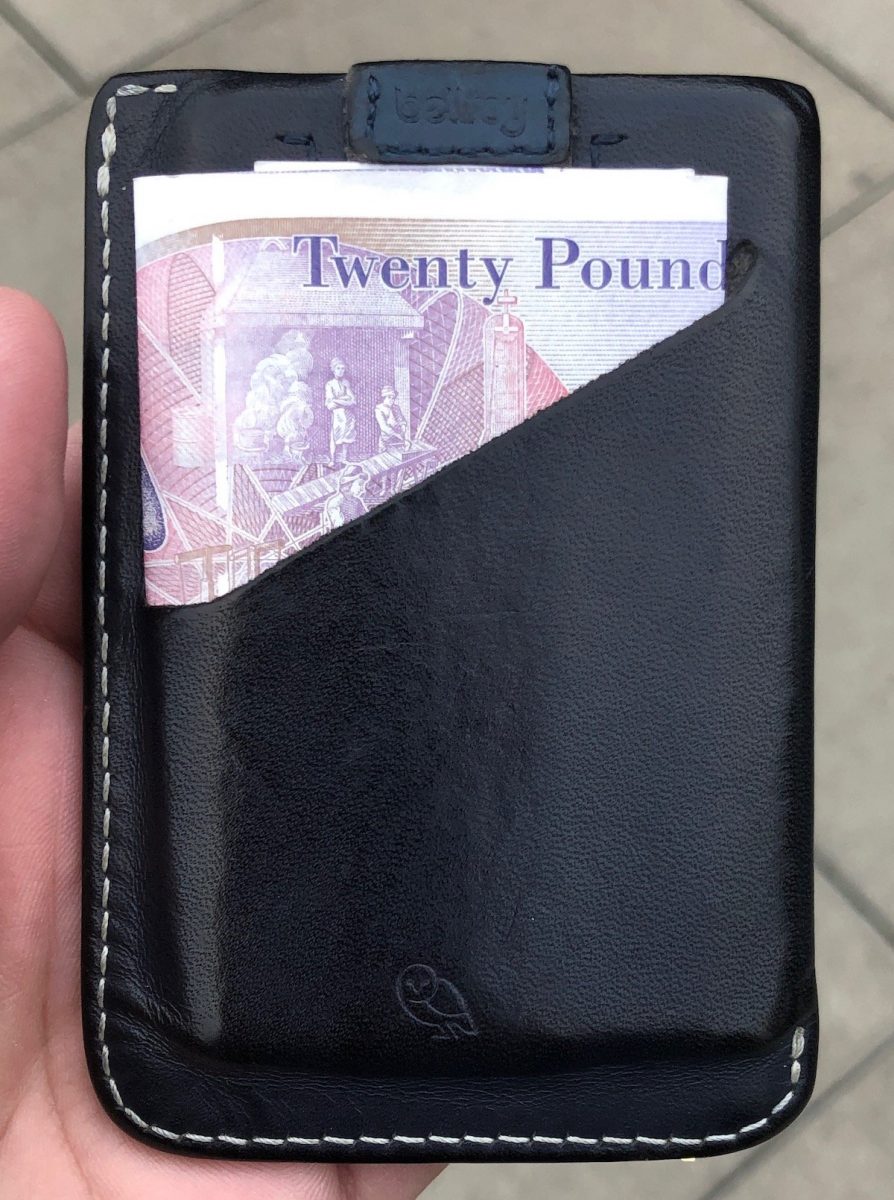
One of the minor advantages to living in England versus the US is the ubiquity of tap to pay. Pretty much anywhere that takes a credit card allows you to use the NFC chip on your credit card or Google/apple pay. The catch has been you can only use it up to £30. After that you need to use the chip and pin. That meant for most day-to-day transactions I was able to use Apple pay on my watch. I kept my belroy slim wallet (pictured) with three credit cards and ID in it along with 20 pounds just in case I needed to spend more than £30.

In late August I read a newsgroup thread talking about how merchant terminals were no longer limiting Apple pay to £30 per transaction. That made sense to me since I bought stuff in the Apple Store for way more than £30 and they didn’t seem to have a limit. What I didn’t realize immediately was I was reading about a change to the banking laws that was coming into effect in mid-September so the terminals were changing their requirements

After September 17 or so there’s no longer a hard limit on how much you can spend with tap to pay. Apple and Google Pay offer 2nd factor authentication already. It’s my face or fingerprint on my phone so there in theory is no additional validation or limit on using my phone or watch to make purchases.

Using a physical card with a NFC chip need to reauthorize with the PIN every hundred pounds or so. This change in theory makes it possible for me to not have to carry a wallet. It also means in theory that using Apple pay is more convenient/better than using an actual physical card.

At the time of writing this it’s been at least two months since this came into effect. Since then i only once had to use a physical card at one merchant. Since this is still an experiment I leave my wallet with an emergency card or two in my bag hidden away. It still also has an emergency £20 note. You know for that rare time I need cash. So far the experiment has been fantastic. Even the one case that i did need my physical card i think the terminal was having issues. Even with the physical card the system had to try twice to make the transaction go through.

Here is to hoping I don’t need to carry a wallet ever again. Well at least in the UK.

So You Want To Move To Another Country Part Whatever: You Need Credit

I have generally been pretty good with my credit. I pay all my balances off every month and my US credit has been excelent for years.

I knew when coming to the UK that my credit doesn’t carry over. I also learned that I might be in the lucky position to be using services from companies that would transfer my credit to their corresponding divisions in the UK.  That is a perk of working with a multi national organisation.

My usage of American Express cards is measured in decades. It makes me feel old. I also remember fondly that my dad thought it was amusing that I had an American Express Gold card in college. He gave me one on his account for any emergency purchases. Thinking about that, it might be its own post at some point. Needless to say after college an American Express card was one of the first cards I got. I was thankful to find out that American Express will issue me cards in the UK based off of my history with them in the US.

Process to get my American Express card in the UK was seamless. I filled out an online form and the cards arrived at our house in London. The cards were literally waiting for us when we got to our house. I cannot say enough nice things about the process from American Express to do this. In this situation membership does have its privileges. Pun intended. The only thing I would comment about my experience with American Express isn’t really a negative since I got something for free. I was going to downgrade one of my cards in the US however I got hard sold into not doing it. They basically gave it to me for free however it’s yet another conversation I  have to have with them later this year. I know they’re expecting me to forget and just pay for it. Be warned Annex I will not forget to call to downgrade that account.

The thing with American Express is even in the United States it’s not excepted everywhere. I heard mixed opinions from British friends on how widely accepted AMEX was. My experience is it is generally accepted the vast majority of the time we go to use it. Is it less widely accepted as in the states? I don’t know, maybe. Either way having it is your only card does limit you. Even in the US I would always have a backup just in case.

That leads me to trying to get a card from my bank. When it became pretty apparent we were going to move we opened an account with a multinational bank that was one of the few that have accommodations for people in my situation moving to new countries. I am writing about my experience in getting accounts created them in another post, so I won’t go into that here. I did sign up for a MasterCard in the United States specifically so I could build up credit history bank so I could transfer that history over to their UK division.

Once living in the UK I waited several months to apply for the credit card via my bank. I delayed partly because I wanted to see how far we can get with AMEX. I also was pretty lazy. I feel that all the forms to apply and then didn’t hear anything for several weeks. Then I get a letter saying I been declined. I was a little surprised. On one hand I do not keep very much money in the UK branch of this bank. I do my day-to-day banking with an online only bank. I didn’t think that would matter since I have a decent amount of funds in other locations with them. The way their whole system works is having funds at one location counts towards the other.

I was rather annoyed by being declined. I was also curious why. I called them to ask and got a bunch of runaround. Finally they filed an official appeal on my behalf. They told me that would be something like 6 to 8 weeks before they got back to me with an answer. Over a month later I got a letter telling me that three weeks after that they should have a response to me. When I finally got a written response all it said was I was declined and they couldn’t really say specifically why. But it may be one of many different factors. I get not having a lot of a credit history would prevent me from getting something from a service provider that I’ve never used before however these guys were supposed to be different. I should not be surprised since the general feedback about them in all of the expected some part of are negative.