The Not Quite Two Day Work Week

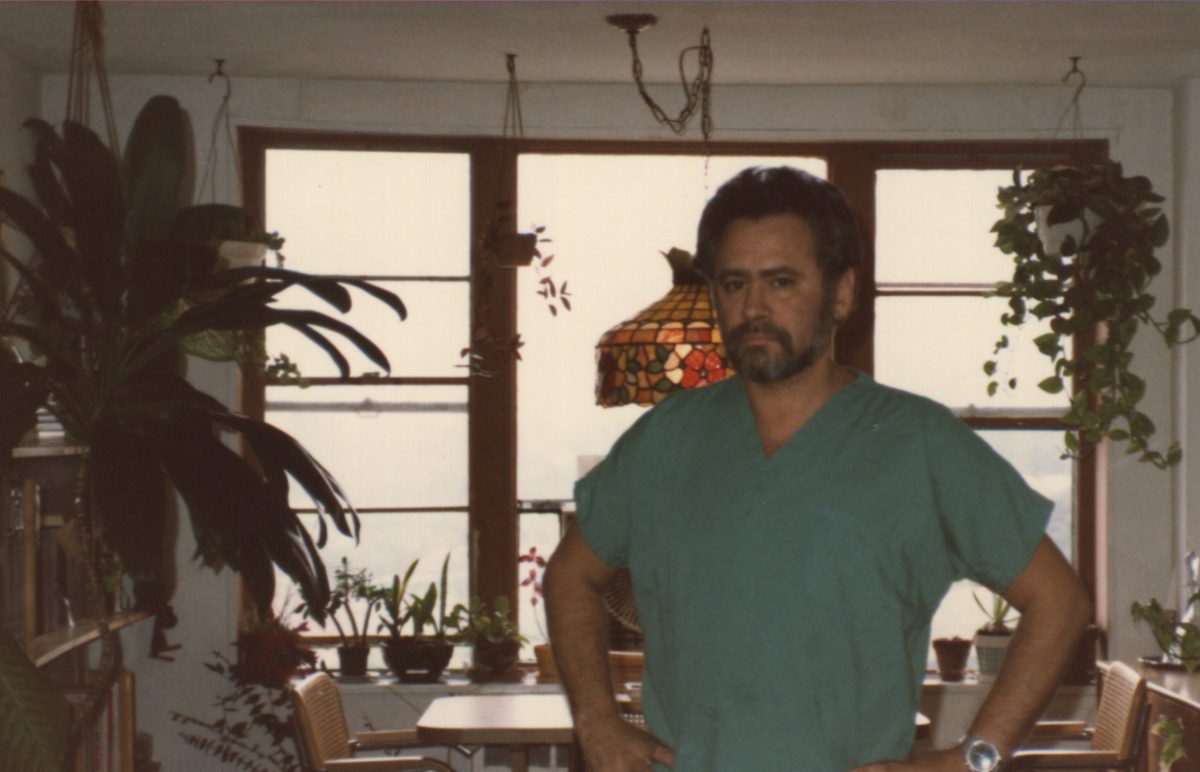
When I was growing up, basically from first or second grade through high school, my dad worked in an emergency room. He worked there before and after that too, but that stretch of time is the one I remember most clearly. And at some point during those years he got promoted and became the group leader for the physician assistants. Which meant he controlled the schedule.

That schedule was, looking back, kind of wild.

He technically worked only two days a week. Tuesdays and Thursdays. But those two days were monsters. He would get up around six thirty in the morning, head out. I rarely saw him in the mornings. He wouldn’t get home until eleven or eleven thirty at night. Eighteen hour days. He would get home long after everyone else was asleep, put on the TV for a bit to unwind, and eventually go to bed. The only reason I know this was because my bedroom was near the living room, so I would hear him come in sometimes.

Those two huge days added up to about thirty six hours a week, and then he had administrative office hours scattered elsewhere. That part was whenever he wanted, so the rest of his week was essentially free time. He used to tell me he loved those early morning drives. He would throw on scrubs, be out the door in minutes, and the roads were empty. We lived in Queens near the Throgs Neck Bridge and he worked in the Bronx, so it was a quick trip. From the way he described it, he was not overly committed to speed limits, and because of his job, I do not think any police officer ever gave him trouble. Then coming home late at night was the same thing. Empty roads, easy ride. He really liked that routine.

Later on, when my sister went to college, he picked up a side job on Wednesdays to help cover tuition. That was at Rikers Island. His hospital had the medical contract there, so once a week he did a four to twelve shift at the prison clinic. He hated that job. They would literally lock him into the clinic area for his own protection and he would sit there with a tiny portable television, because this was the late eighties and entertainment options were pretty much nonexistent. If something happened, they would either bring an inmate to him or escort him out to whoever needed care. He did it strictly for the money, and he knew the exact week he was planning to quit because that was the moment he would no longer need the extra income our college tuition’s.

When I got older and went off to college, he still had the same overall routine. I would call my parents on Sundays for the usual check in, but if I wanted to talk specifically to my dad, I would call him on Wednesday mornings before he left for Rikers. He told me once that I was one of the only people who ever called him on Wednesdays. Everyone else avoided him because he was grumpy about going to that job and made sure the whole house knew it. But I always knew he would be home on those mornings, and for whatever reason, I never minded calling then.

Eventually he moved out of the emergency room entirely and into a more administrative role. More of a normal nine to five thing. That was sometime toward the end of my college years, and there is another whole story about how he got that job, but that is for another day.
Downsizing the Pi Network

I keep a blog idea board in my Trello app so I can track all the things I want to write about, because I’ll come up with an idea for a post and then promptly forget it. Of course, sometimes I also add it to the board and still forget about it for years. By the time I rediscover it, the topic isn’t relevant anymore, or I’ve already written something similar. But I digress.

One of those old notes was about the state of my Pi network. I wrote it down a year ago, maybe updated it earlier this year, and now I’ve finally made enough changes that it’s worth revisiting.

I’ve owned pretty much every generation of Raspberry Pi. Actually, I think I’ve owned all the main variants from each generation, not the tiny ones or the 400/500 models that are built into keyboards, but all the standard boards. I bought the original Raspberry Pi 1, set it up, played with it, and then never really deployed it for anything meaningful. By the time I wanted to, the Pi 2 had already come out, so I bought one of those. At some point I got rid of the Pi 1, maybe gave it away, but I’ve kept just about every other one since.

The backbone of my original home network was built on Raspberry Pi 2s. I had five of them running my early private cloud backup network. Over time, I upgraded them with new cases, official Wi-Fi adapters, and less reliance on Ethernet. Then the Pi 3s came out, and I added a few of those for compute jobs. Then came the Pi 4s, and I gradually shifted everything over again.

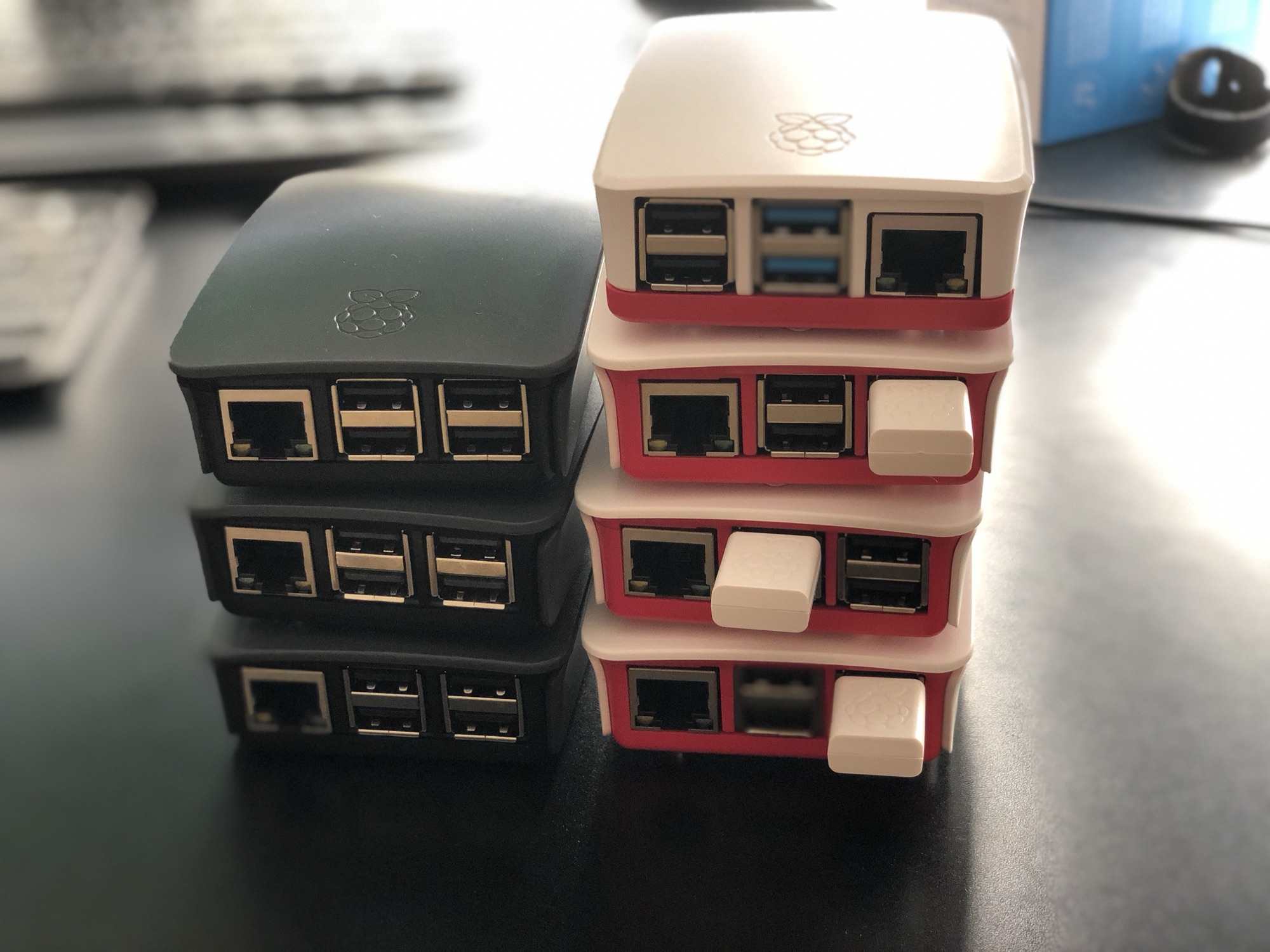
Eventually, I stopped using the 2s and most of the 3s, and my little network of Pis became mostly 4s. I think I had around four or five of them running various workloads. When the Pi 5s came out, I didn’t jump immediately, but I have about four of them now.

Funny thing is, I’m using less compute now than ever. The main purpose of the Pi cluster used to be my Docker setup, which ran parts of my media center, a Minecraft server, and Homebridge for connecting Ring cameras to Apple HomeKit. Most of that has since moved or shut down.

I replaced the Ring cameras, so no need for Homebridge. Plex moved to my Synology DiskStation because the transcoding works better there. The Docker stack was easy enough to migrate, so that freed up another Pi.

These days, I’m really only using:

One Resilio Sync node for backups One BorgBackup setup for immutable backups One Pi as a Tailscale exit node And a Raspberry Pi 4 running Pi-hole for DHCP and DNS in the house

Everything else runs on Pi 5s, though even that’s more power than I need. When I built out the 5s earlier this year, I decided to stop using SD cards and external drives. I got cases with SSD add-ons, most with 256 GB drives, and one with a 2 TB SSD for backups. It’s a neat all-in-one box setup.

The Pi 4, especially the 8 GB version, is still a perfectly good piece of kit, but I just don’t have enough for it to do. So I’ve started selling them off on eBay. I’ve already sold a couple of the 4s and gotten a surprisingly good return for hardware that’s several years old. I’ve sold all of my 3s and am now selling the 2s. Apparently, people still buy them for nostalgia or small projects.

A few of my old ones are in official cases, and two are even in LEGO cases with camera kits. They look great, but I’m trying to pare everything down so I’m left with only the Pi 5s, and maybe I’ll move the Pi-hole over to a 5 while I’m at it.

Maintaining the hardware takes a decent amount of time and effort, and with what I’m doing now, renting a virtual private server is just simpler. My web hosting, where this blog lives, runs on a VPS with 2.5 GB of RAM, a single virtual core, and about 40 GB of storage, all for around $23 a year. It’s based in Dublin and does the job beautifully.

Building a Pi 5 setup can easily cost around four times that, even if it gives me more power than I’ll ever use. I’m not planning to get rid of the 5s I already have since they’re great machines, but I’ve reduced what I actually run on them. Justifying keeping all the older models sitting around isn’t really there anymore. For most of what I run these days, a VPS or my upgraded DiskStation handles it fine.

So yes, I’m officially downgrading, selling off hardware, consolidating services, and simplifying. I still love tinkering, but the Pi 5s are plenty. The rest? Off to eBay.

My Imaginary Friends (A 15-Year Tradition I Didn’t Mean to Start)

When M and I were just dating, we ended up one night at Rudy’s, that dive bar on 10th Avenue in Manhattan, somewhere in the 30s or 40s, where you get a free hot dog with every drink. I still have no idea why that’s their thing, but it’s a thing.

Anyway, we were walking in, and right by the door there’s this big pig statue. Like, a life-size pig, standing upright, greeting everyone as they stumble inside. I don’t remember if I was the one who wanted to take a picture with it or if M said, “Hey, you should totally take a picture with that weird pig,” but either way, I did.

Side note: while we were trying to get this very important photo, some very drunk woman tried to insert herself into the moment. She might have been hitting on me, which was equal parts awkward and hilarious, because M and I both just stood there like, “Ma’am, no.” We brushed her off, got the photo, went inside, had a drink (and a hot dog, probably), and that was that. A fun night, a random photo, end of story. Or so I thought.

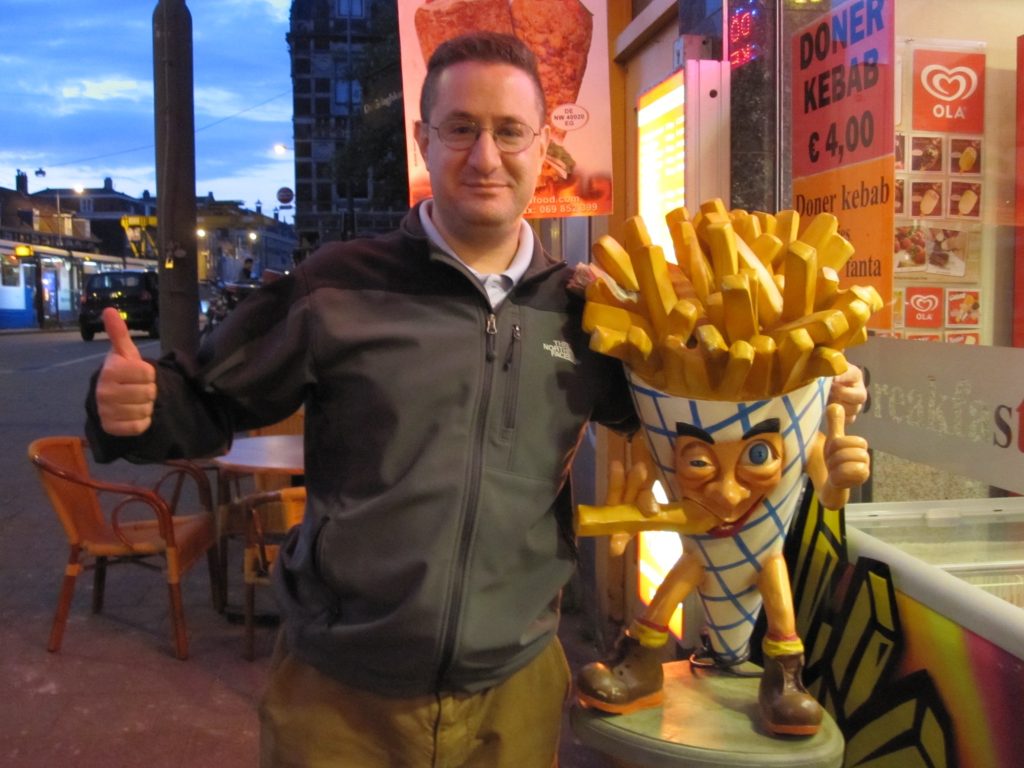
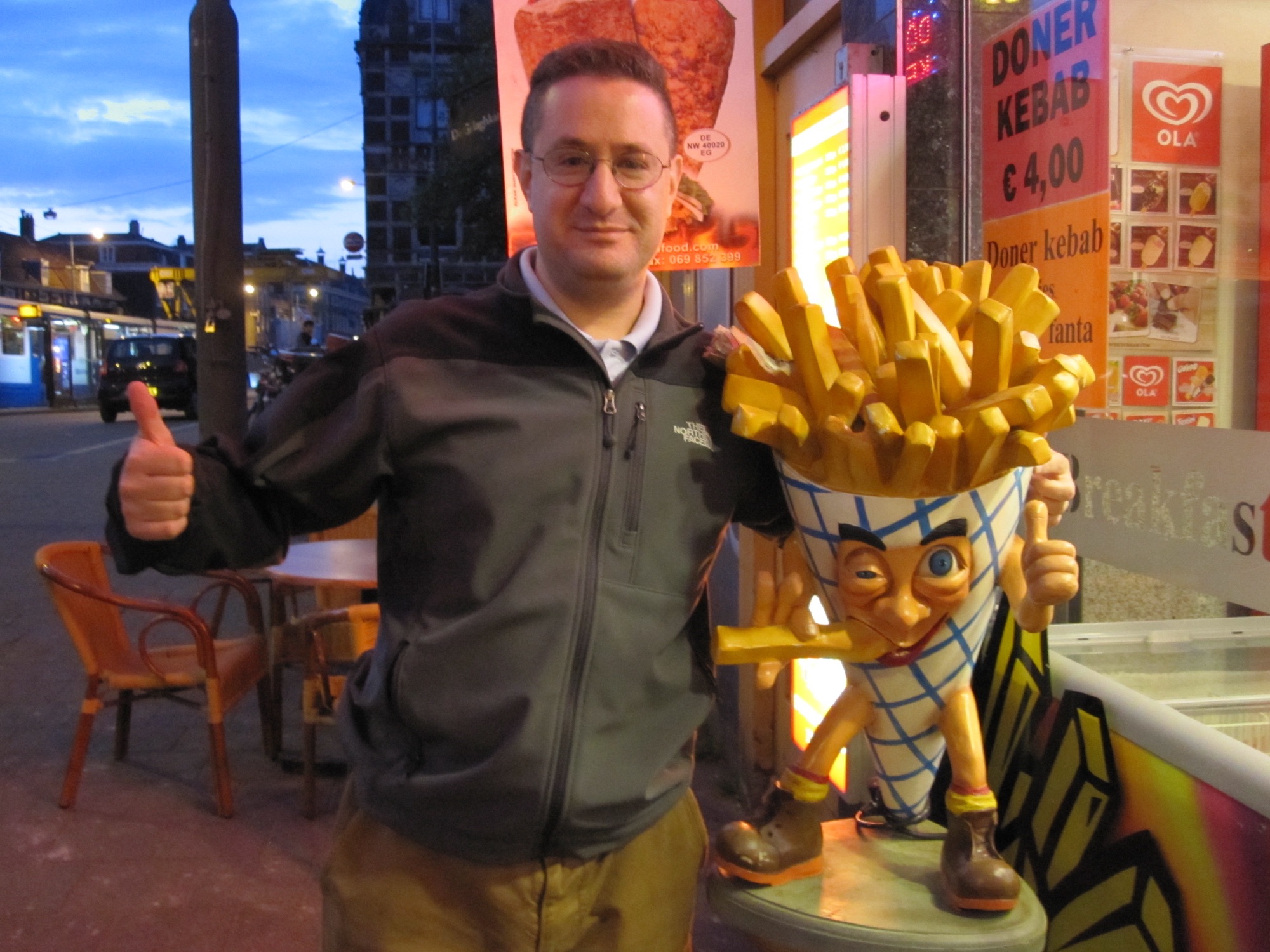
Fast forward less than a year later, we’re in Amsterdam. I take another photo, this time with a giant anthropomorphic French fry container. (If you’ve been there, you know exactly what I’m talking about.) And somehow, without meaning to, it became a thing.

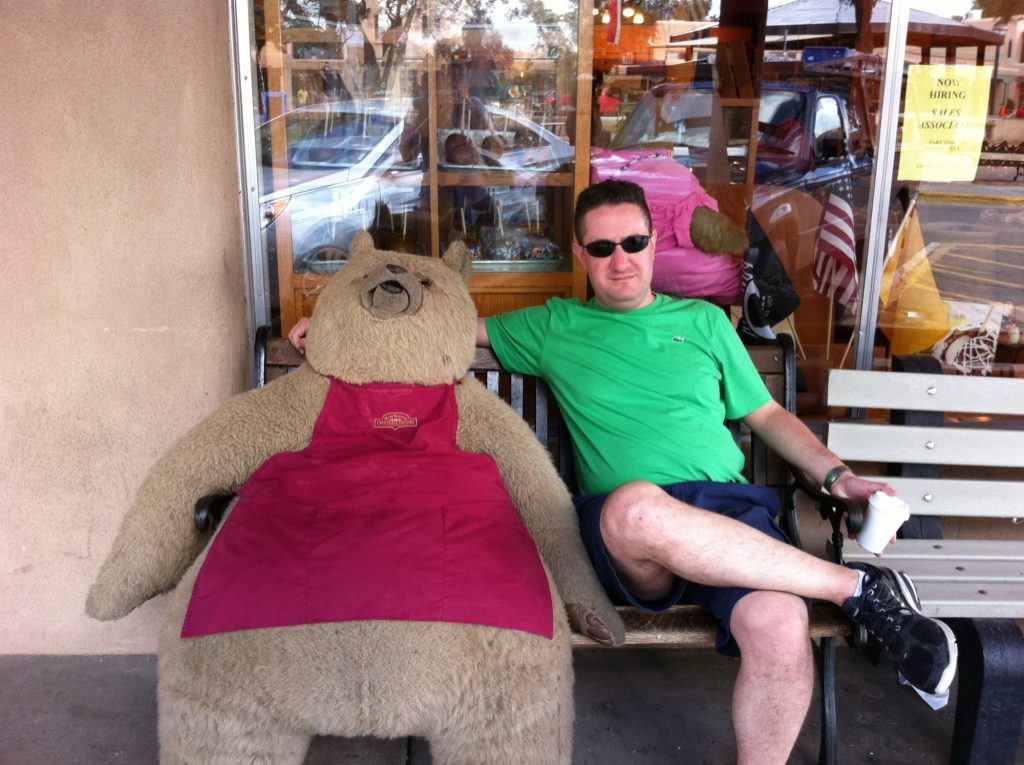
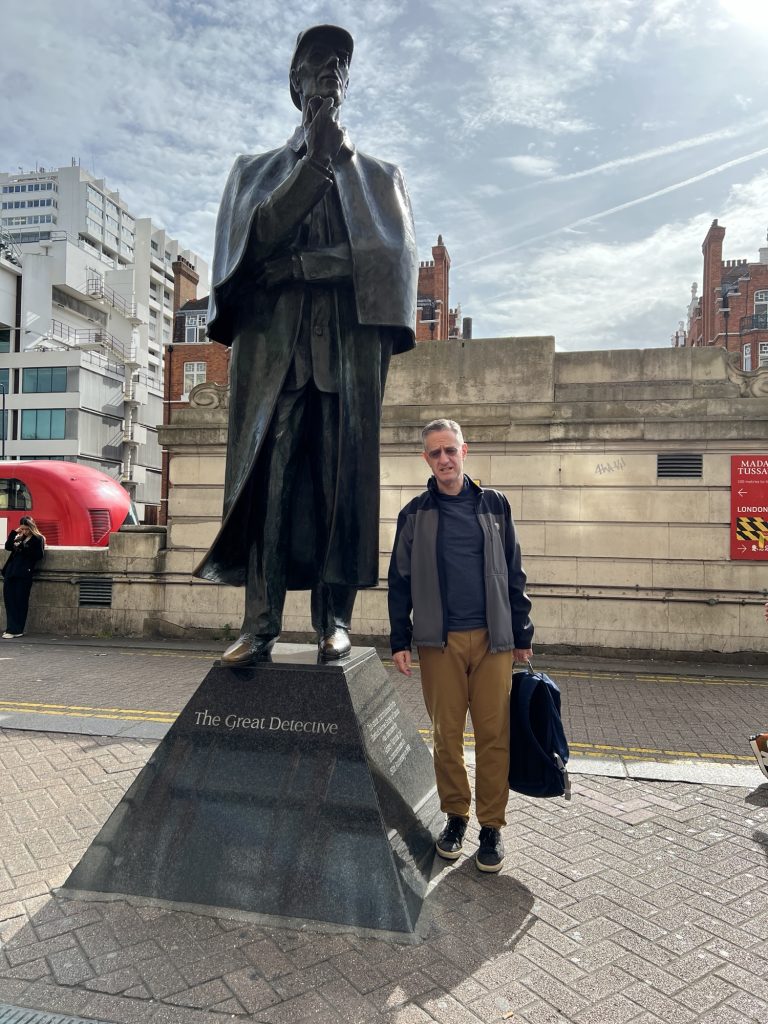
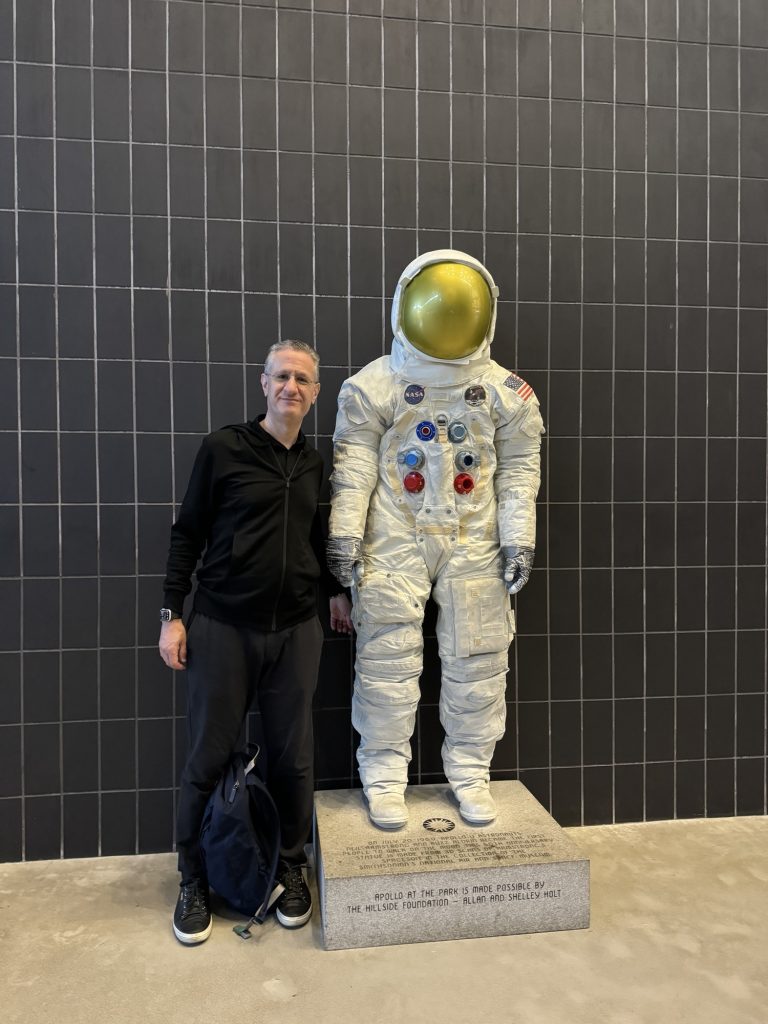
Over the years, it’s turned into this quiet little tradition: whenever I come across an inanimate character, statue, mascot, random object with a face. I have to take a picture with it. Doesn’t matter where I am. A cruise ship, a street corner, a theme park, an airport gift shop. If it’s there, I’m probably posing with it.

I’ve got photos with everything from a teddy bear sitting on a bench in New Mexico to Winston Churchill and Sherlock Holmes statues in London. There’s one with a giant Hello Kitty in Bangkok. The list goes on. At this point, I probably have a hundred or more of these photos—enough to make a coffee table book no one asked for.

I’ve started calling them my imaginary friends. I know, they’re not actually imaginary (or alive), but “inanimate friends” just doesn’t have the same ring to it.

Now that the kids are older, they sometimes join in, or they play photographer while I strike my now-traditional pose. Sometimes I’ll get a picture with them, then immediately request a solo shot because, well, tradition.

I didn’t plan this. I didn’t set out to start a collection. But here we are, fifteen years later, and it’s one of those odd little through-lines in my life that I can’t help but keep going.

I might even try to count how many I’ve got, challenge accepted.

So yes, this is a thing. A ridiculous, wonderful, slightly embarrassing thing that makes me smile every time. And now, you know about it too.

Michael

A week ago today I was in New Jersey for the funeral of my brother in law, Michael. On January twenty sixth, he lost a short battle with cancer.

He was the closest thing I will ever have to a brother.

Yes, I actually have two other brothers in law, and I get along with them. With one of them, I even have a lot more in common than I ever did with Michael. But my relationship with Michael was always different. It was its own thing.

We were not inseparable. We did not spend huge amounts of time together. But we got along easily, naturally, and without effort.

He was one of the most colourful people I have ever known.

On the flight from London to New Jersey for the funeral, I was texting with two of my oldest friends from college. One of them said something that stuck with me, something I had recently been talking to someone else about as well. A good friend is someone who, even after years of not speaking, you can pick up with immediately, as if no time has passed at all.

That was Michael.

We might go long stretches without talking, but when we did, it felt like we had just seen each other yesterday. No catching up required. No awkwardness. Just an easy continuation.

Like I said, he was a very colourful guy, and there are stories. Plenty of them. I will write about some of those later.

But for now, this is all I have.

I am going to miss my brother.

Please Take My Money (Sort Of): Zizzi Edition

Here’s another entry in my ongoing series about payment apps and POS systems, otherwise known as “please, for the love of all things, take my money.”

This time, it’s about Zizzi.

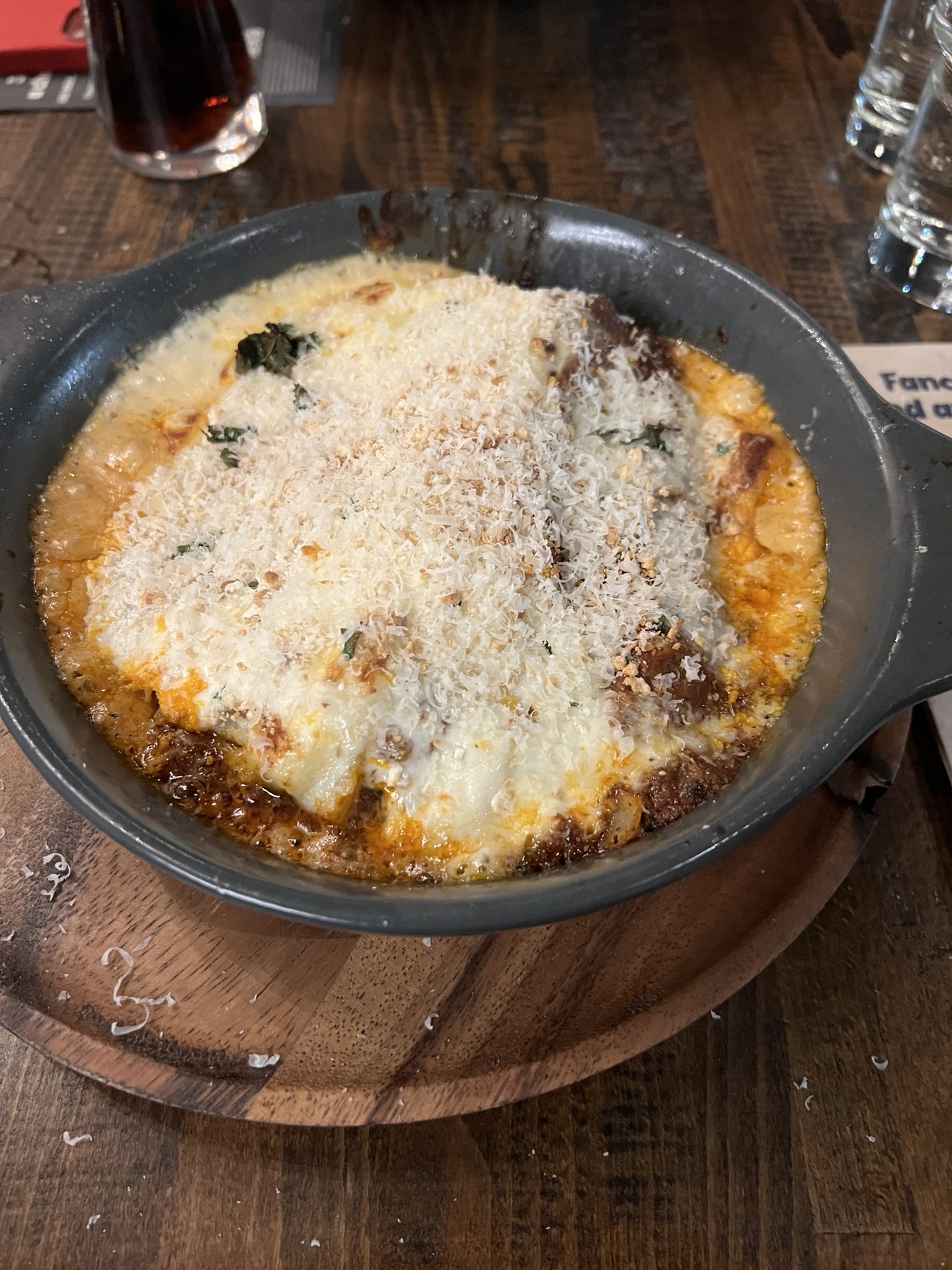
We like Zizzi. Pretty good for a chain, consistent, close to home. The kids enjoy it, and I’m a sucker for a solid lasagna, so it works.

A while back, they introduced the option to order right from your table. You scan, browse the menu, and place your order online. In theory, convenient. In reality, not so much.

The first time we tried it, the whole thing collapsed like a bad soufflé. I think we spent 15 minutes trying to order before admitting defeat. Then the waiter came over, who, to their credit, also had trouble with the system. When the staff can’t make the app work, that’s not a user problem. That’s a “this is broken” problem. Logging in, confirming the order, something always failed. After twenty minutes of tech support cosplay, we gave up and just ordered the old-fashioned way.

Since then, I’ve avoided the “order at the table” gimmick. My appetite doesn’t need a debugging session before pasta.

That said, Zizzi redeems itself with their payment setup. That’s where they actually get things right. You scan the QR code, pay with Apple Pay (no logins, no fuss), and it just works. Recently we had one of the kids’ birthday dinners there, large table, chaos, cake, the usual. The service was great, and paying through the app was quick and clean.

There was one hiccup: the app didn’t let us add a tip. And we really wanted to, because the staff had gone above and beyond with the birthday stuff. We ended up having to flag someone down, who couldn’t add it either. Apparently, the built-in service charge meant we were done. Nice in theory, but awkward when you actually want to leave extra.

Still, credit where it’s due. Ordering? Fail. Paying? Solid.

Zizzi gets a mixed review from me, half frustration, half appreciation. The tech that takes my money works great. The tech that takes my order? Not so much.