You Get What You Get And You Don’t Get Upset

When the girls were in nursery school in New York, they learned all sorts of things, as you’d expect. But a few stuck with me because they were catchy little rhymes meant to help them remember. One of those has stayed with me all these years, and I still use it as a reference today:

You get what you get and you don’t get upset.

The teachers would say it when the kids were picking teams, or snacks, or whatever else was being handed out. Naturally, some kids would get upset if they didn’t get exactly what they wanted. The rhyme was a simple way to set expectations and keep things fair.

I love it because it’s so blunt, so true, and surprisingly useful. These days I use it now and again at work. People often want to do things that simply aren’t possible, and they’re not thrilled with the alternatives. That’s when I’ll joke that I learned long ago from my kids’ nursery teachers: you get what you get and you don’t get upset.

It always makes me laugh. Not everyone finds it as amusing as I do, but it’s one of those little truths of life that’s hard to argue with.

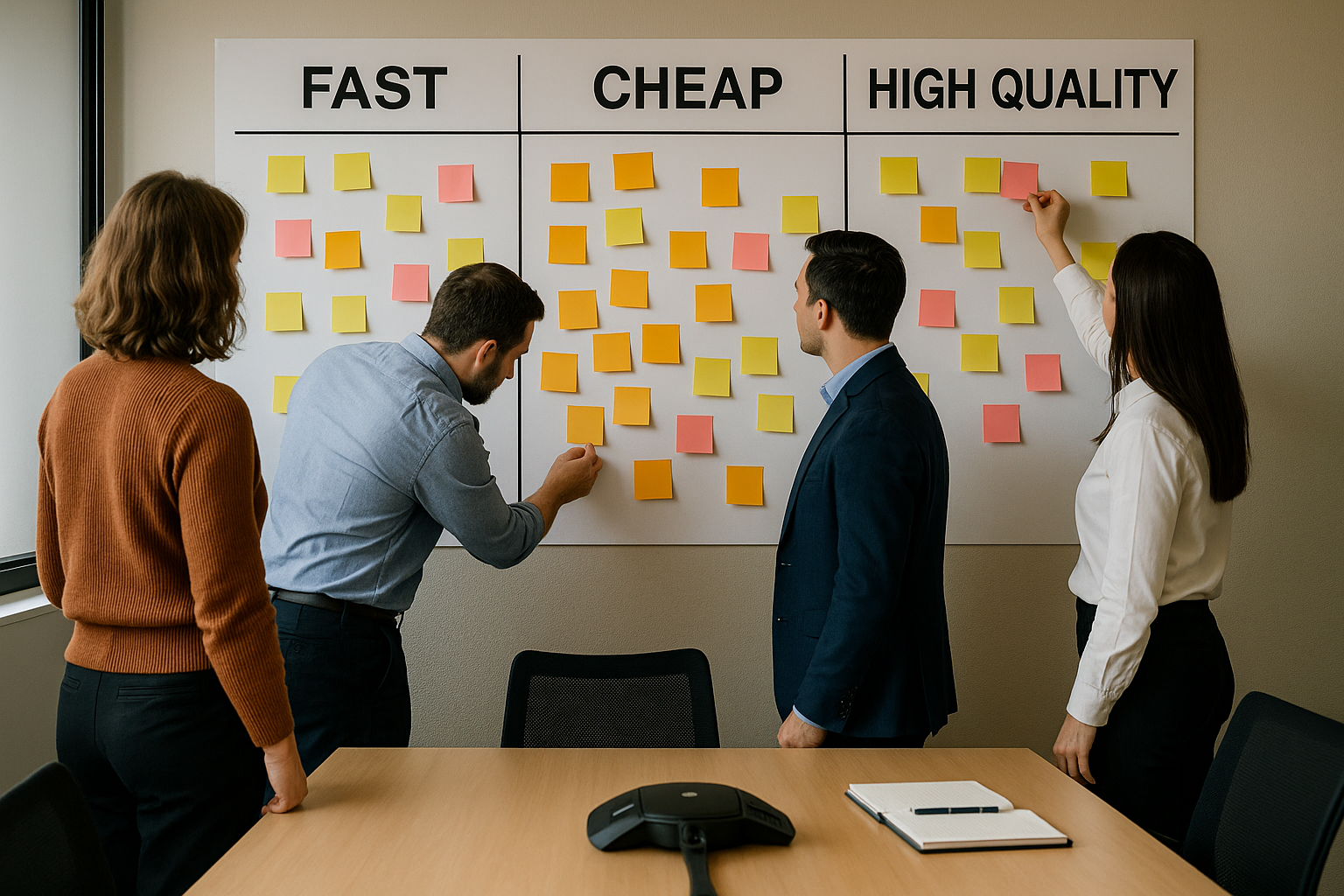
Fast, Cheap, High-quality?

I’m not sure where I first heard it. One of the high-performance team trainers I worked with back in my implementation days around 2013 must have taught it to me. The saying goes: when you’re delivering something, you can have it fast, cheap, or high-quality. The catch is you only get to pick two. That statement still rings true over 10 years later. I bring it up in conversations all the time, and no one has managed to prove it wrong yet.

The real challenge is that everyone always wants all three. Life is about trade-offs, and this rule makes the trade-offs unavoidable. The hardest part is that people don’t usually want to accept it right away. They only come around once reality sets in.

Maybe someday, maybe even someday soon, AI will make this saying obsolete. But so far, it hasn’t.

17th Workaversary

Today marks my 17th work anniversary. I haven’t done a retrospective of the numbers involved in a few years, so it felt like time for an update.

It’s still only been three companies: Thomson Reuters, Refinitiv, and now LSEG. Back in my 2022 update, I mentioned I was moving into a new role. Three years later, I’m still in that role. So here’s how the breakdown looks on this workaversary:

8 offices 2 continents 12 managers (4 of them just in the past 3 years) 7 different groups across those 17 years (though the lines blur a bit, since lately I’ve been helping out in a group outside my own)

The most important part isn’t the numbers, though. Even if it can feel a little discouraging to watch people you’ve known and liked move on, I still find the work exciting, the problems worth solving, and the culture a place I want to show up to every day.

The Story of Saying No to Sushi

The last few years I spent living in New York City and working at Thomson Reuters before moving to England I was part of a team that, for most of my time there, was based in the same office as me. When I first started in NY, that wasn’t the case. I worked in an office where nobody I directly collaborated with was present. Eventually, the team grew, and most of the group ended up in our New York office. Today i am somewhere in the middle with much a the team in London but the people i daily communicate with spread out all over.

Having the team all together brought a lot of positive outcomes. Group meetings were more effective since we were often in person, which was a nice change from the typical phone meetings. One of the best parts was going out for lunch or coffee together. But by the time our lunches became a regular thing, I was trying to be heathier. Going out to eat several times a week didn’t align with my health goals, so I’d often skip lunch outings and opt for a sandwich in the cafeteria instead. However, I made up for it by joining the team for coffee once or twice a day.

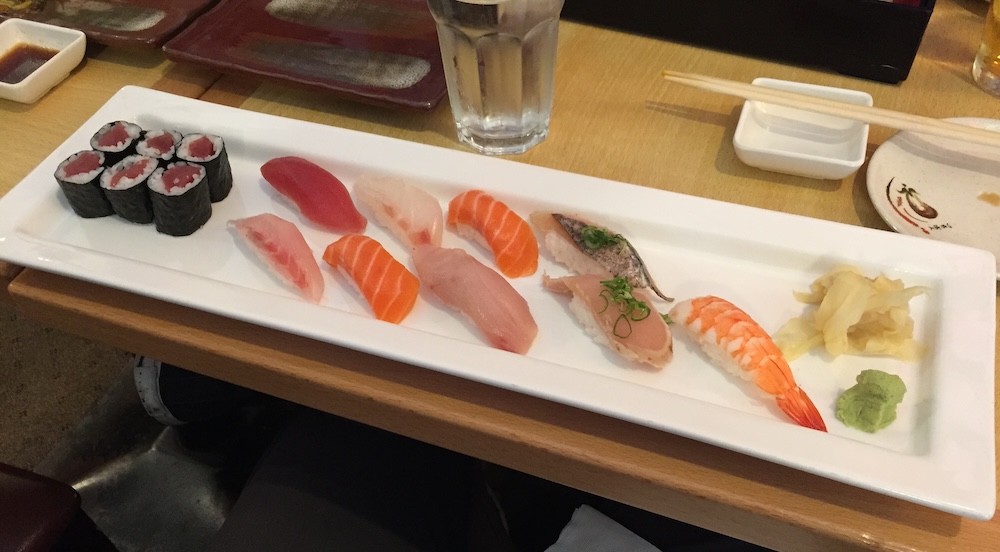
The one exception to my lunch rule was sushi. It was relatively healthy, and I enjoyed it. Or it was healthy enough and I rationalised it as being ok. Whenever the team went out for sushi, I would usually join them. Over time, this became a bit of a pattern. I’d ask where they were going for lunch, and if it was anything other than sushi, I’d politely decline and stick to my sandwich. But if it was sushi, I’d think about it and often end up going with them.

That’s when my friend Faisal caught on to my pattern. If I declined to join for lunch, he’d jokingly suggest, “What if we go to sushi?” I’d grumble, and we’d end up at the sushi place. He started doing this more frequently, and I’d tell him they didn’t need to change plans just for me. I really didn’t want them to. But he would insist it was fine because several others loved sushi anyway. So, I’d curse him (playfully, sort of), and off we’d go—rinse and repeat.

It was delicious. Now, my current team is full of great people, and we get along well, but we’re rarely in the same office. Even when we are, it’s so hectic that we don’t have time for lunch outings. In a way, that’s good because I’m not tempted, but I do miss those sushi lunches with my New York team. I did recently get added to a chat group specifically for deciding were to go out for lunch to. I haven’t yet participated but you never know!

Operations is Just Like The Fire Department Minus The Burning Buildings…

Many years ago when I was working at a startup and my manager at the time (still a mentor to me today) was very adamant that I read Failure Is Not an Option by Gene Kranz. It’s about the NASA mission control from the earliest days of Mercury through Apollo. You might not know who Gene Kranz is however if you’ve seen the movie Apollo 13 he is the character portrayed by Ed Harris. The book is a fascinating read for anyone. I found it especially interesting since a lot of what I do in operations is planning for the unexpected and incident management when things do go badly.

The person suggesting I read the book wanted to have me model our group a lot like mission control. A lot of what I read and learned did carryover into day-to-day life running ops in a startup. When I began to realize though was we are much less like mission control then we are like a fire department. Yes we have to plan for the unexpected and have clear methods of work for what we do expect to happen when it comes to pass. We also need to think like the fire department. The most basic sense what that means is if you get a call that something’s wrong you show up like it’s a five alarm fire. Even if you think it’s just a cat in a tree you show up in full turnout gear ready to go. If it turns out to be just a cat in a tree one guy stays behind takes care of the situation and everyone else breaks and returns back to the station. However if what sounded like a cat in a tree turns out to be something more substantial you’re ready to go and you can jump into action.

What I just described is exactly what we do when starting an incident recovery call.  You have to act like Emergency services do. You have to constantly drill people. No matter what the situation sounds like you go in assuming the worst.  Even after false positive after false positive you still have to go into every situation like a major event. The alternative can be disastrous.

I originally wrote a version of this entry years ago after several large incidents me and my team had been handling. Its sentiment still holds true several years later.  Since then I have been using this analogy a lot. It holds true for me several groups later in dealing with incident management. What took me a little while to realise after first writing this is that the same analogy goes for training initiatives as well. When a fire department isn’t going on calls for maintenance in their equipment their drilling. In order to have quick reactions in situations they know they have to work together as a team and drill together the scenarios that likely will come up. In the group I managed at the time I wrote this we did a lot of training.  To the point where people were complaining of training. Yet the outcome of the drills and training were reaction times improved a noticeable amount. No one can be expected to be shown something once and be executed perfectly six months later when it comes up again. We all need to constantly drill using the tools we have while working together in common likely scenarios that may come up.

At the time of first writing another example of Ops acting like the fire department was we had a situation that put the fire department mentality to the test. We received an email around a problem that had been kicking around with others for two days. At first pass it didn’t sound like it was much to do with our group however it didn’t feel right. We were not sure what was going on so we made the decision to mobilise to rule anything out. It was the right decision. The lead of our incident recovery call confirmed after a few hours that there was a problem, identified the upstream service, and got the right people engaged to solve the issue. The same type of thing could have come in and been nothing. Many times it is nothing. By mobilising we headed off a potentially worse problem.

In that group back in 2016 my manager at the time gave me a baseball bat that I kept at my desk.  He used to use it when talking to people to tell them if they ran into issues he could help with getting things done.  He gave it to me in a very public way to show my team I could do the same for them. It was an important symbolic gesture. I never really used it but it was nice to roll around on the floor or otherwise fidget with it during a long incident. When I moved out of that operations group to a more delivery role the person who took over from me was a good friend of mine.  I made a very public hand over to him of the same bat. When still doing day to day operations stuff I had been meaning to get around to buying a fire hat. I feel that is more appropriate token to have around. Now a days its less appropriate since I am not doing operations / application support.


15 Years

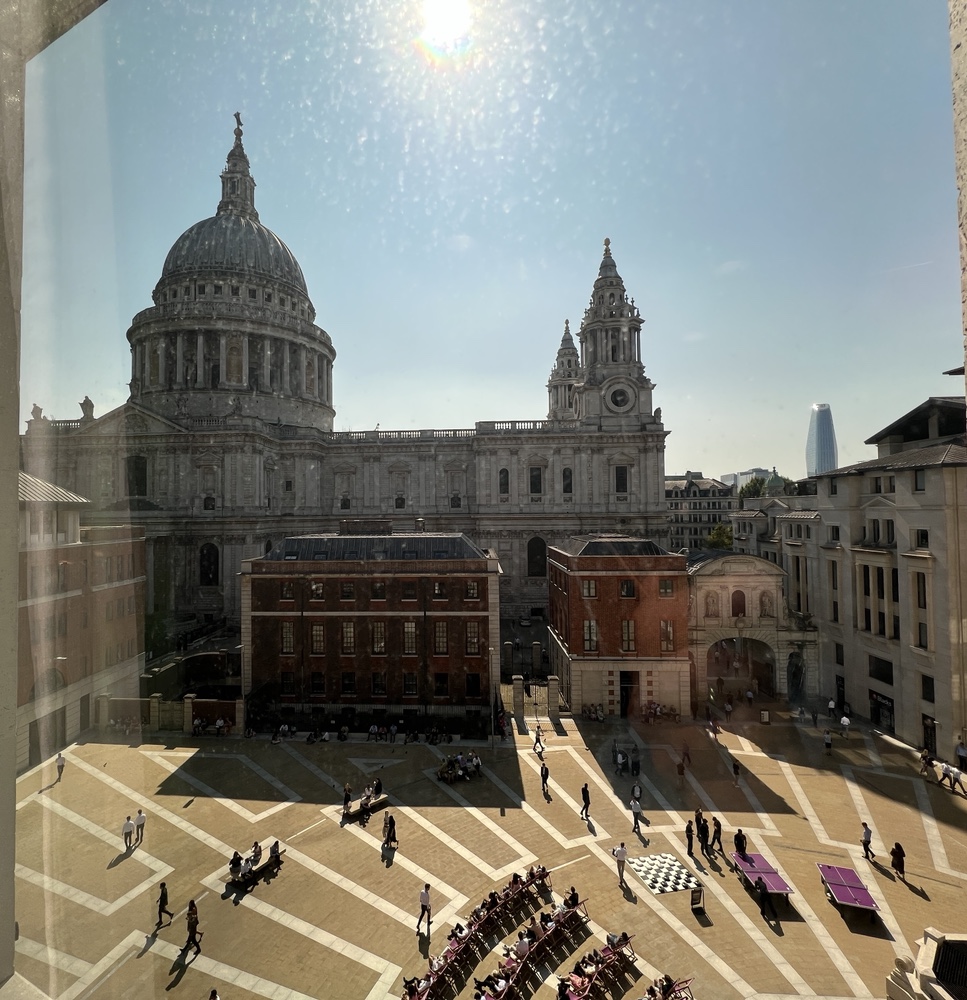
I wanted to write something to mark my 15th anniversary at LSEG (Thomson Reuters, Refinitiv, LSEG). So much has changed with me and the world . Yet I still get excited by a view like this one out of our conference room during a workshop today. It’s a very different view from my memorable ones out of the office in Times Square or Docklands, but just as energising.

It also helps to still be working with people who make every day fun even after 15 years.

6,000 Days

A totally random useless yet nostalgic data point for today. It has been 6,000 days since I started at Thomson Reuters. I thought the nice round number was cool.

I would never have guessed were that journey would take me, yet here i am a divestiture, and acquisition later in another continent.

Photo taken outside 3 Times Square after i accepted the offer and before i started.

A New Role at Work

I can finally say that I have started a new role today at work. Saying I have moved roles isn’t new.  I have done so on average about every 1 to 2 years over the past 14 years at Thomson Reuters / Refinitiv / LSEG. This change feels different. Since as far back as 2018 it became clear to me that I wanted to do more in the Security area of Technology vs the Operational area that had been working in. Since then I have tried to spend as much time as I could personally and professionally in the security area with my main role still being operationally focused.

In 2020 right before COVID-19 hit I applied for a role in a Security Architecture group. The timing was not good due to the pandemic. At the time i was a bit disappointed however it worked out in the long run. A few months later another role presented itself that was still in Operations (Reliability Engineering). It was however a good career progression for me. I wouldn’t have thought to go out for it until prompted.  Advise from that is listen to people you trust.

Flashing forward to this year I was interested in a role that came up. I was talking to my previous manager about it. She was very encouraging and gave me some advise i did not initially act on. A few months later I approached someone doing a similar role I was interested in. I was looking for advise on what I could do to beef up my skills so I could apply for the role. The response I got was I should just apply. So I did.

I got the offer in late July.  I have been transitioning with ever increasing amounts of time in the new role since August.  Today is the first day I am full time in the new role.  It is a bit anticlimactic since i have been spending most of my time in the role for most of October.

What is funny to me is the role is very different in many ways however at the core is still the concepts of DEV SEC OPS. It is just approaching the problems from a different angle. That is overly simplifying things a bit  How i go about my work is vastly different now.  There is also so much to learn however that is the fun part.

Now I need to start explaining to people what a BISO is and stop explaining what Reliability Engineering is. I do have some confidence now that my wife will stop telling people (very incorrectly) that I am a project manager.

14 Year Workaversary

Today marks my 14th work anniversary. As with life so much is different now and so much is the same. Whenever i write about a work anniversary i have been running down the numbers related to my life since September 8, 2008. This year will not be any different.

When I started in Sept 2008, it was at Thomson Reuters. Since then I have technically worked at 3 companies. First Thomson Reuters, then Refinitiv, and now LSEG. This year my numbers are not as straight forward as in the past. I am in the process of transitioning into a totally new role. The transition is not done yet however since i have started doing the new role i am going to count the changes that role brings into these numbers.

I have worked out of 8 offices, across 2 continents. I have had 10 managers. Oddly in the past 5 years i have had 7 of those 10 managers. I have been in 7 different groups across those 14 years. Of course the lines blur a bit with the groups in some cases.

On a personal side in the same 14 years I have lived in 3 apartments and one house. Moved continents, gotten married, and had 2 kids.