
The Stories Behind My Dad’s Omega Speedmaster

I’ve written before about my dad’s Omega Speedmaster Professional, now my Omega Speedmaster Professional, and how he passed it down to me. But before I forget, I want to write about a few of the stories he told me about that watch. They’ve always stuck with me.

When I first got it, I thought he’d bought it in 1969. Turns out that wasn’t true. After some research, the serial number puts it around 1970 or 1971. When my dad was still alive he confirmed that timeframe. Still, an absolute classic.

One thing he told me that always made me laugh was how Omega almost never buys back their old watches, but more than once, when he sent it in for maintenance, he claims they offered to buy it from him. He always said no.

My dad was a physician assistant who worked in trauma and surgery, so the watch saw some things. He used to joke that it had been sterilized more times than he could count, which, considering where it had been, I appreciated hearing.

He told me about one time when one of the links on the band came apart while he was literally working inside someone’s chest, and the watch slipped off his wrist. They had to fish it out, clean it thoroughly, and fix the band afterward. I still have that original band, so I know it got fixed.

I can’t imagine that would be allowed now. I don’t know what the current hospital rules are, but I’m guessing “no watches in open chests” is probably written down somewhere these days, sterilized or not.

When I tell people that story, some of them are grossed out, others think it’s amazing. I’m firmly in the “amazing” camp. It’s history, after all.

Another quirk is the bezel. Instead of the usual tachymeter, his has what Omega called a pulsometer bezel. It’s what I grew up seeing on his wrist, so to me, that’s just what the watch is supposed to look like. When I had it serviced maybe ten years ago, they asked if I wanted them to replace it since it doesn’t rotate anymore. I said absolutely not. The bezel’s part of its story.

Years ago, when I was living in New York, I brought it to the Omega Boutique for maintenance. The guy behind the counter said he’d have someone take a look and disappeared into the back. A few minutes later, an older gentleman, clearly one of their watchmakers, came out excited to see it. He thought the pulsometer bezel was great and said it was a really special piece. He also told me they could do the service in-house instead of sending it back to Switzerland, which was a relief. Apparently if it was slightly older it would need to travel for service.

It was nice seeing someone else appreciate it that much. That old watchmaker was genuinely happy to work on it.

I don’t wear the original metal band anymore, it was always a little loose even when my dad wore it, and apparently that specific band design is rare now. So I keep it stored safely and use a NATO strap instead.

It’s funny how polarizing this watch can be. Some people hear its stories and get squeamish. Others think it’s the coolest thing ever. I’m clearly in the second group.

Every time I take it in for service, it still gets attention. It always starts a conversation. And I love that.

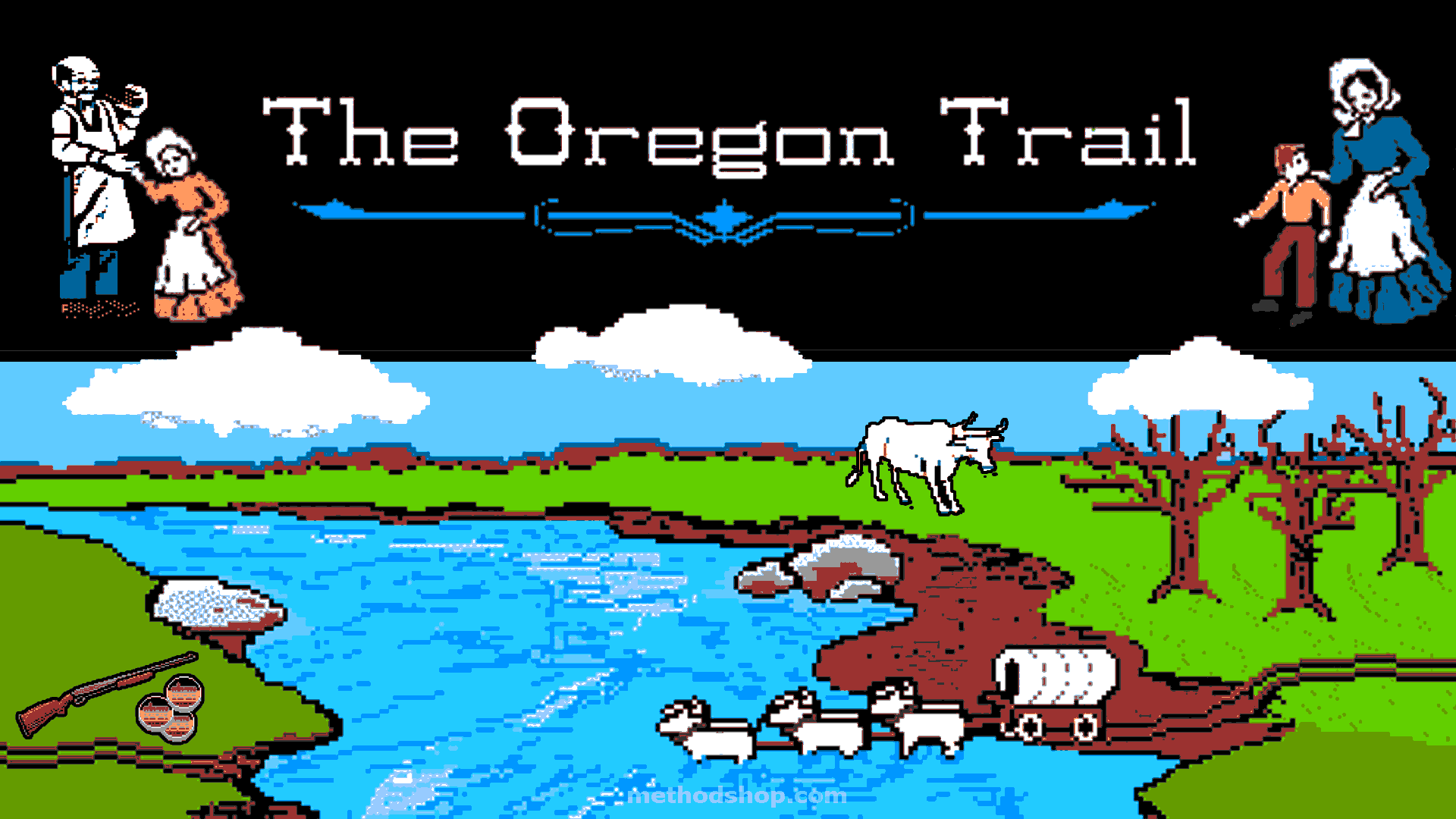
The Oregon Trail, Carmen Sandiego, and the Apple II

When I was in middle school, I loved going to the library. I’d volunteer there, and they had computers. Lots of them.

They were mostly Apple IIs, but there was one Apple IIGS, the “fancy” modern one. Looking back, it’s funny to think how high tech that seemed at the time.

The library had games, and the two I remember most were The Oregon Trail and Where in the World is Carmen Sandiego? (or one of the other Carmen Sandiego versions). I can’t remember exactly which ran on which machine, probably both on the Apple II at some point, but I do remember how much fun they were.

The graphics were awful by today’s standards, but that didn’t matter. The gameplay and the stories were great. Oregon Trail had those wonderfully stick figure graphics, and Carmen Sandiego was all text and deduction, but both were surprisingly immersive. They pulled you in.

Fast forward to now: there’s an Oregon Trail game on the Apple TV. My kids have played it. It’s wild to see something that defined a tiny part of my childhood sitting there as an app on the TV. And it’s actually hard, way harder than I remember. Maybe 11 year old me was terrible at it, or maybe I’ve just gotten soft.

The kids haven’t played Carmen Sandiego, but they’ve watched the Netflix animated version. So somehow it all comes full circle, a game I played in a school library on a beige plastic Apple II in Queens has become a glossy cartoon they stream in 4K.

It’s funny how that works. I can still picture that room at IS 227, the horse shoe setup of old Apple IIs humming away, green screens flickering, and me trying to ford a river without losing half my wagon party.

Some memories just stick.

Please Take My Money: Green King

It’s time for another round of Please Take My Money, the ongoing saga of payment systems that either make it ridiculously easy to spend money or somehow turn it into a test of patience and willpower.

Today’s contestant: Green King.

When I think back, I don’t even remember Green King having an online payment system before COVID. Maybe they did, but it certainly wasn’t memorable. Then lockdown happened, and suddenly the idea of ordering from your phone became not just convenient, but essential.

After restrictions lifted, one of the first places we went was our local Green King pub. For the first time, they had an online ordering option. I actually thought that was great. One thing the pandemic got right, if we can say that about anything, is the ability to order food and drinks from your table instead of waiting in line at the bar.

Now, don’t get me wrong, I like the charm of a proper English pub. I don’t mind going up to order a drink. But queuing to order food? Hard pass. So the fact that Green King introduced mobile ordering felt like progress.

Originally you had to register for an account. Nothing kills “convenience” faster than “please create a password.” I get that companies want to collect data and “build loyalty,” but if you’re in the business of selling me a sandwich and a beer, maybe focus on that. I don’t need another account to forget about.

Anyway, once I begrudgingly registered, it worked fine. I could order food, add my table number, and my meal magically appeared without waiting at the bar. That alone put Green King ahead of some others I’ve tried. So let’s call the early days a neutral: annoying sign-up, but decent execution.

Fast forward a few years, and they’ve clearly learned. The app no longer requires you to store your card details. You can just pay with Apple Pay or Google Pay and be done. No extra forms, no saved card nonsense, no trust fall into yet another company’s database.

And that’s the thing. Retailers love to say they “take security seriously.” The reality is that they may not be able to focus on it as deeply as a credit card company or a bank does, which is understandable. So when an app lets me not store my card details, that’s a feature, not an inconvenience. It’s basically zero knowledge in practice. If they ever get hacked, it won’t matter, because my card details were never there to steal in the first place.

These days, ordering through Green King’s app is smooth. You tap, pay, and your order’s on its way. Seamless. Efficient. Almost enjoyable.

So, after a rocky start, Green King has graduated from “barely tolerable” to “actually pretty great.” They finally figured out the assignment: make it easy for me to give you my money.

The Dot Group Problem

This post is partially channeling my wife’s outrage, but as the household tech support department, I’m equally annoyed.Here’s the story.

The .group top-level domain (TLD) launched in 2015. I know this because I looked it up after dealing with this nonsense. My wife has a personal domain name using .group. It’s short, simple, and sounded nice and professional when we registered it.

We both use a mail service that supports unlimited aliases. Every new website or service gets its own unique email address. That way, when one of them leaks or gets sold, we know exactly who’s responsible for the spam. It’s a great system.

Today, for example, I got an obviously dodgy email pretending to be from a legitimate service provider. It was already flagged as spam, but even if it hadn’t been, I could tell it wasn’t real because it was sent to an alias I’d only ever used for a different service. Case closed.

So yes, that whole “unique email per service” setup works brilliantly. And my wife has adopted it too, with some encouragement from me and a bit of technical assistance.

Now here’s where the outrage begins.

It’s 2025. The .group domain has been around for ten years. There are hundreds of new top-level domains now. And yet, there are still websites out there that refuse to accept an email address ending in .group.

She’ll try to register for something, type in her perfectly valid address, and the site throws back: “Please enter a valid email address.” Excuse me? It is a valid email address. The site’s validation code just isn’t built to handle it.

This drives me absolutely mad. I’ve built and supported web applications for years in e-commerce, corporate systems, and startup products. It’s baffling that companies still don’t invest in maintaining their websites properly. Maybe they don’t know how modern validation should work, or maybe they just haven’t prioritized it. Either way, it’s not a great look in 2025.

Our fix was simple, if slightly irritating: we bought another domain. It’s not quite as clean or memorable as the .group one, but my wife liked it, and it works. It’s a standard .uk domain, which every site on the planet seems to accept without complaint.

Problem solved, more or less. The new domain costs about five pounds a year, which is fine. The annoying part is that the .group domain, the one she can’t use everywhere, is about three times that price. But it’s tied into too many existing services to just drop.

That’s the real downside of using custom domains for email. Once you build your digital life around one, moving away from it is basically impossible.

So now, our workaround is simple. We’re keeping the .group domain active for existing logins and old services but using the new .uk address for anything new.

It’s not the fault of the .group registry. It’s just a side effect of how unevenly the web is maintained. Some companies build things properly, others never update. And here we are, ten years later, still running into “invalid email address” errors for perfectly valid ones.